Course Content
1. Principles of Plastic Materials
Go beyond the name on the resin bag. Discover how a plastic's internal structure (amorphous vs. crystalline) dictates its flow, shrinkage, and final part strength. Learn to predict how your material choice will behave inside the mold before you even design it.
0/3
2: Principles of Plastic Injection Molds
Master the anatomy of the most important tool in manufacturing. We'll decode the blueprint, naming every component from the mold base to the hot runner nozzle. This is the essential language you need to communicate, design, and troubleshoot.
3: Rheology of Plastic Materials
Why does plastic flow? We unlock the science of flow behavior. Learn to calculate pressure drops through runners, predict filling patterns, and scientifically select substitute materials that will work in your existing mold.
4: Basic Calculations of the Injection Molding Process
Replace guesswork with engineering. Perform the three critical calculations for any mold: the clamping force needed to keep it shut, the energy required to cool it, and the design of the cooling channels to make it efficient.
5: Filling Systems
Design the highway that delivers plastic to the cavity. From spruce and cold runners to advanced hot runner systems, learn to size, balance, and analyze every element. We'll cover power needs, thermal expansion, and how to prevent defects at the gate.
6: Construction Materials
Choose the right steel for the job. Move past generic recommendations. Learn to read performance charts, analyze steel chemistry, and select materials for wear, polish, or cooling. Plus, master the protocols for repairing molds by welding and inserts.
7: Simulation Systems
See the future of your mold before it's built. Learn to use CAE simulation as a powerful engineering tool—not a black box. We'll cover how to set up studies for new molds, troubleshoot existing ones, and critically interpret results to prevent costly mistakes.
Plastic Injection Molds
About Lesson

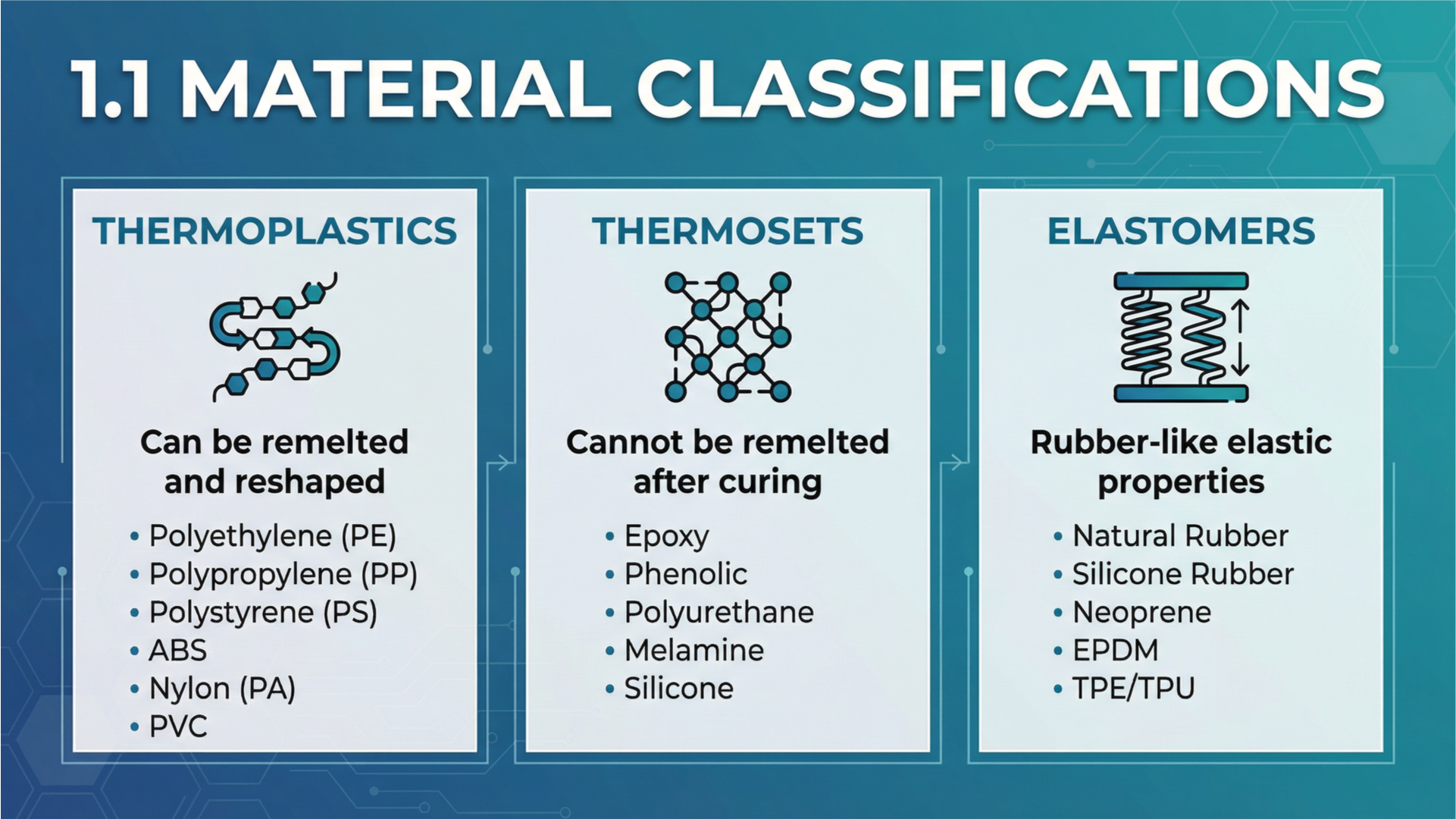
This unit provides the essential vocabulary of plastics engineering. It covers the classification of polymers into:

  • Thermoplastics vs. Thermosets: Based on molecular structure and recyclability.

  • Amorphous vs. Semi-Crystalline: Based on molecular arrangement, which dictates key properties like shrinkage, clarity, and chemical resistance.

  • Common Polymer Families: Introduction to key material groups (e.g., Polyolefins, Styrenics, Engineering Plastics, High-Performance Plastics) and their general characteristics.

  • Additives and Fillers: How modifiers (glass fibers, minerals, flame retardants, plasticizers) alter the base resin’s properties and processing.

Exercise Files

1.1 Material Classifications.pdf
Size: 4.69 MB
0% Complete
1
  • Item added to cart
1
Carrito
Placeholder
Plastic Injection Molds
1 X $49,00 = $49,00
    Calculate Shipping
    Apply Coupon
      //
      Realiza tu pregunta te responderemos lo mas pronto posible.
      👋 Hola, ¿Cómo te ayudo?

      ¡Bienvenido a tu nueva página web!

      Es hora de configurarla:

      Desde el menú ingresa a “Menú de administrador” para comenzar a crear tu nueva página web. En tu panel encontraras videos que te ayudaran a configurar tu web de forma fácil y rápida.